
The Hidden History of Plants: Hops — The Plant That Built Monasteries
The Hidden History of Plants: Hops — The Plant That Built Monasteries
For most people today, hops are little more than a flavoring ingredient in beer. They are associated with craft breweries, bitter IPAs, and frothy pints poured in crowded taprooms. But long before hops became a symbol of modern brewing culture, this climbing vine quietly transformed Europe. It preserved beer, supported medicine, strengthened monastic economies, and helped build entire religious communities.
The history of hops is not just the history of beer. It is the story of survival, trade, medicine, and devotion. In many ways, hops helped shape medieval Europe itself.
What Are Hops?
Hops come from Humulus lupulus, a perennial climbing plant native to Europe, western Asia, and parts of North America. The female flowers — known as hop cones — contain aromatic resins and oils rich in compounds such as lupulin, humulone, and lupulone. These compounds are responsible for the plant’s bitter flavor, preservative qualities, and distinctive aroma.
Before hops became common, most European beer was flavored with herbal mixtures called “gruit,” which often included yarrow, mugwort, rosemary, bog myrtle, and juniper. These blends varied widely and spoiled quickly. Beer was unstable, inconsistent, and difficult to transport over long distances.
Hops changed all of that.
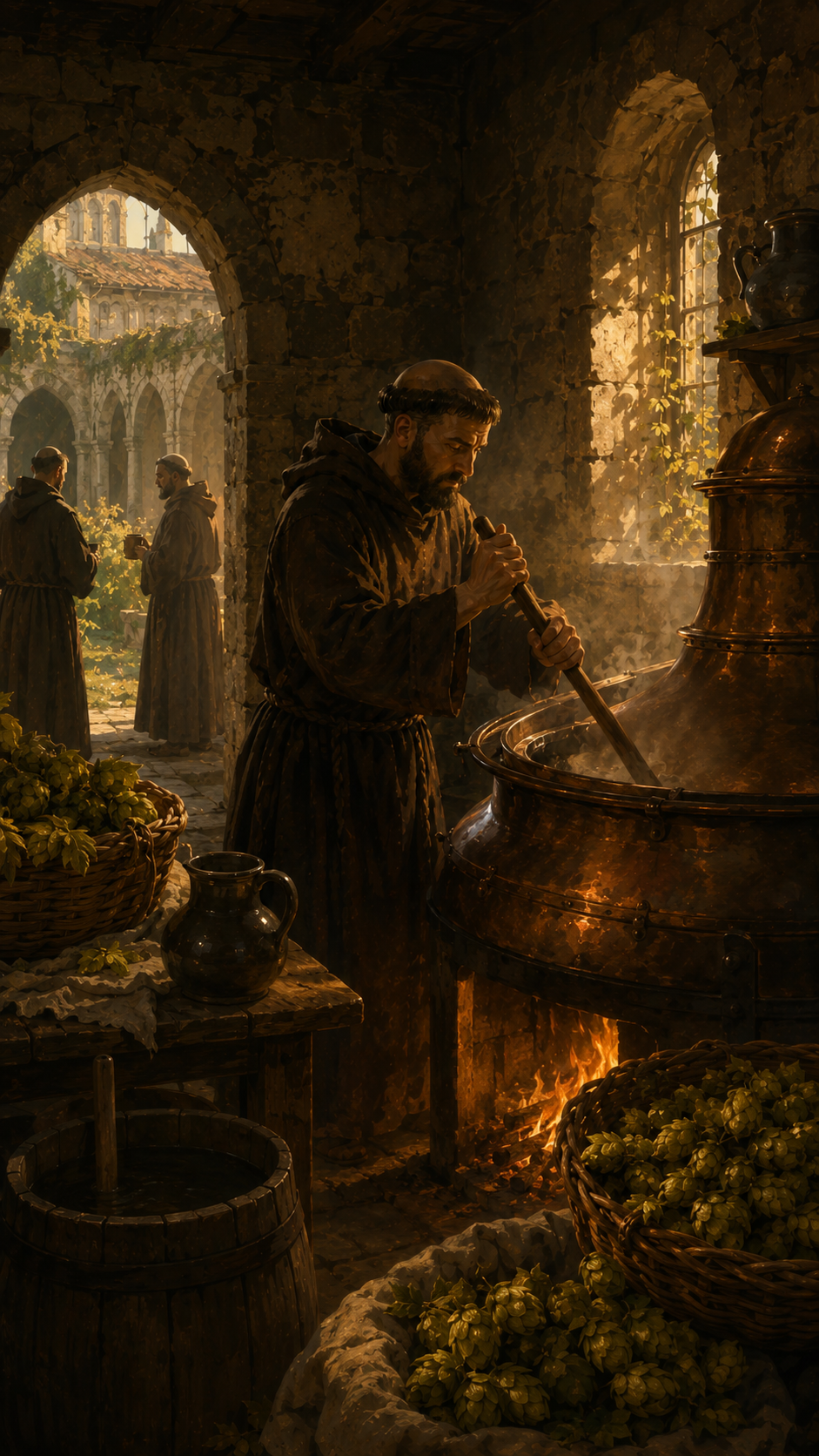
The Rise of Monastic Brewing
During the early Middle Ages, monasteries became centers of agriculture, medicine, scholarship, and brewing. Monks brewed beer not only for themselves, but also for pilgrims, travelers, and surrounding communities. In many monasteries, beer was safer to drink than contaminated water.
By the 9th and 10th centuries, monastic brewers began experimenting with hops as a replacement for gruit. The results were revolutionary.
Hops gave beer a longer shelf life by slowing bacterial growth. This allowed monasteries to store beer for extended periods and transport it farther for trade. Beer became more stable, more profitable, and more consistent.
As brewing expanded, monasteries developed into powerful economic centers. Some abbeys became famous for their beer production, using hops to support entire communities through trade and agriculture. In regions across Germany, Belgium, and Bohemia, hop cultivation became tied directly to monastic success.
In many ways, hops helped monasteries thrive financially during the medieval period. Without hops, large-scale brewing may never have become sustainable enough to support these religious institutions.
Hildegard of Bingen and the First Written Praise of Hops
One of the earliest written endorsements of hops came from Hildegard of Bingen, the 12th-century Benedictine abbess, herbalist, and scholar.
In her medical writings, Hildegard described hops as useful for preserving beverages, noting their bitterness and ability to prevent spoilage. While she believed the plant could contribute to melancholy if overused, she recognized its extraordinary practical value in brewing.
Her writings are among the earliest surviving texts documenting hops in beer production. This helped legitimize their use across monastic brewing traditions.

Beer as Medicine
In medieval Europe, beer was often viewed as both nourishment and medicine. Hops themselves were believed to possess calming and restorative qualities.
Traditional herbalists used hops for:
Restlessness and sleeplessness
Nervous tension
Digestive complaints
Pain and inflammation
Modern research has found that hops contain compounds with mild sedative properties, helping explain their longstanding use in sleep remedies and calming herbal preparations.
Hop pillows — small cloth sachets filled with dried hop cones — became popular folk remedies for insomnia. Their aroma was believed to quiet the mind and encourage sleep.
Even today, hops are commonly combined with valerian root in herbal sleep formulas.
The Economic Power of Hops
As demand for hopped beer spread across Europe, entire regions became dependent on hop cultivation. Towns prospered from hop farming, beer exports, and brewing taxes.
By the late Middle Ages, hopped beer from northern Germany was being traded internationally through the Hanseatic League. Beer had transformed from a local household product into a major commercial industry.
The Bavarian Beer Purity Law of 1516 — known as the Reinheitsgebot — formally recognized hops as one of the essential ingredients of beer, alongside water and barley. This law helped standardize brewing practices and further cemented the dominance of hops in European beer production.
What began as a monastery experiment eventually reshaped economies across the continent.

Hops in the Modern World
Today, hops remain deeply connected to brewing culture, but their story extends beyond beer.
Herbalists still value hops for their calming properties. Extracts and dried hop preparations are used in teas, tinctures, and sleep blends. Researchers continue studying the plant’s antioxidant compounds, antimicrobial potential, and phytoestrogen content.
Meanwhile, craft brewers have elevated hops into an art form. Thousands of hop varieties now exist, each producing unique aromas ranging from pine and citrus to floral and tropical fruit notes.
Yet beneath all of this modern innovation lies the same ancient plant that once helped sustain isolated monasteries centuries ago.
The Plant That Built Monasteries
Hops did more than flavor beer.
They preserved it.They stabilized trade.They supported monasteries.They strengthened economies.They shaped agriculture across Europe.
What appears today as a simple brewing ingredient was once a plant powerful enough to influence religion, commerce, medicine, and daily survival.
The next time you smell the sharp bitterness of hops, you are experiencing a living connection to medieval brewers, candlelit abbeys, and the quiet agricultural revolution that changed Europe forever.
Works Cited (MLA Style)
Behre, Karl-Ernst. “The History of Beer Additives in Europe — A Review.” Vegetation History and Archaeobotany, vol. 8, no. 1, 1999, pp. 35–48.
Hieronymus, Stan. For the Love of Hops: The Practical Guide to Aroma, Bitterness and the Culture of Hops. Brewers Publications, 2012.
Hough, J. S. The Brewing Industry and Beer Culture. Cambridge UP, 1982.
Moir, Martin. “Hops — History, Traditions, and Uses.” Economic Botany, vol. 54, no. 4, 2000, pp. 489–496.
Unger, Richard W. Beer in the Middle Ages and the Renaissance. University of Pennsylvania Press, 2004.
“Hop.” Encyclopaedia Britannica.



Comments