
The Hidden History of Plants — Garlic: The Protector Against Death
The Hidden History of Plants — Garlic: The Protector Against Death
SEO Focus Keyword: Garlic health benefits
Secondary Keywords: history of garlic, medicinal uses of garlic, allicin benefits, natural immunity remedies
Introduction: A Plant That Defied Death

For thousands of years, garlic has carried a reputation that borders on myth. Known scientifically as Allium sativum, this humble bulb has been called everything from a sacred offering to a weapon against disease—and even death itself. Across cultures and centuries, garlic has been used not just as food, but as medicine, protection, and ritual.
But behind the folklore lies something far more powerful: a long, documented history of real medicinal use, now supported by modern science.
Ancient Origins: Garlic as Medicine and Strength
Garlic’s recorded use dates back over 5,000 years. In ancient Egypt, it was valued so highly that it was placed in the tombs of pharaohs. Workers who built the pyramids were reportedly given garlic daily to enhance strength and endurance—an early recognition of its physiological effects.
Greek and Roman civilizations followed suit. Greek physicians, including Hippocrates, prescribed garlic for a variety of ailments, including respiratory issues, parasites, and digestive disorders. Roman soldiers consumed it before battle, believing it enhanced stamina and resilience.
This wasn’t superstition—it was observation. Garlic worked.
The Middle Ages: Protection Against Plague
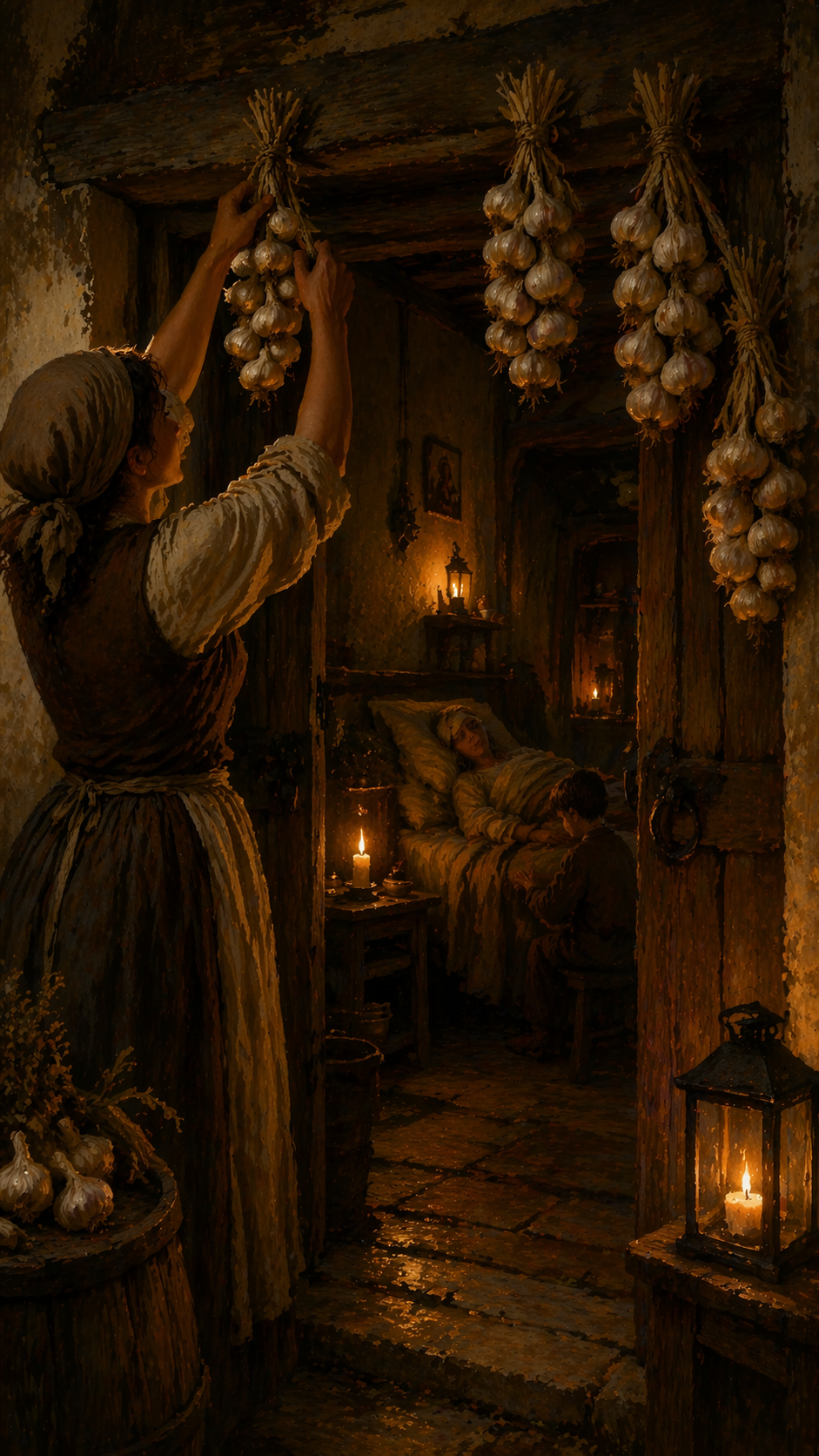
Garlic’s reputation as “the protector against death” truly took hold during the Middle Ages, particularly during outbreaks like the Black Death.
At a time when medicine was limited and poorly understood, garlic became a frontline defense. It was worn around the neck, hung in homes, and consumed daily. Some historical accounts describe grave robbers—later referred to as “Four Thieves”—who used garlic-based concoctions to protect themselves while looting plague victims.
While these stories are often exaggerated, they point to a critical truth: garlic was consistently associated with survival during times of widespread disease.
The Science Behind the Power: Allicin and Antimicrobial Action
What ancient cultures didn’t know—but modern science confirms—is that garlic contains potent bioactive compounds. The most important of these is allicin, a sulfur-containing compound released when garlic is crushed or chopped.
Allicin has been shown to have:
Antibacterial properties
Antiviral effects
Antifungal activity
Immune-supporting capabilities

Studies suggest that garlic can help inhibit the growth of harmful microorganisms, supporting the body’s natural defenses. This gives real scientific backing to its historical use during times of infection and illness.
Garlic in Traditional Medicine Systems
Garlic has held a central role in multiple traditional healing systems:
Traditional Chinese Medicine (TCM): Used to support digestion and respiratory health
Ayurveda: Considered warming and stimulating, used to enhance vitality
European folk medicine: Used for infections, wounds, and immune support
Across these systems, one theme remains consistent—garlic was used to protect the body from internal and external threats.
Modern Applications: From Kitchen Staple to Functional Medicine

Today, garlic is one of the most widely consumed medicinal foods in the world. It is commonly used to support:
Cardiovascular health (cholesterol and blood pressure regulation)
Immune function
Inflammation reduction
Garlic supplements and extracts are now standardized for allicin content, allowing for more controlled and measurable therapeutic use. Clinical research continues to explore its role in preventing chronic disease and supporting overall health.
Separating Myth from Reality
Let’s be clear—garlic is not a miracle cure, nor does it literally prevent death. But its historical reputation didn’t come from nowhere.
What ancient cultures interpreted as protection from evil or death was likely the result of garlic’s ability to:
Reduce infection risk
Support immune response
Improve overall resilience

In other words, garlic didn’t make people immortal—it made them harder to kill.
Conclusion: The Legacy of a Protector
Garlic’s story is one of survival. From the tombs of Egypt to the plague-ridden streets of medieval Europe, it has stood as a constant ally in humanity’s fight against disease.
What makes garlic remarkable isn’t just its history—it’s the fact that its ancient uses continue to be validated today. Few plants have bridged the gap between folklore and science so completely.
In a world filled with synthetic solutions, garlic remains what it has always been:
A simple, powerful, and enduring protector.
Works Cited (MLA Format)
Block, Eric. Garlic and Other Alliums: The Lore and the Science. Royal Society of Chemistry, 2010.
“Garlic.” National Center for Complementary and Integrative Health, U.S. Department of Health and Human Services, www.nccih.nih.gov/health/garlic.
Rivlin, Richard S. “Historical Perspective on the Use of Garlic.” The Journal of Nutrition, vol. 131, no. 3, 2001, pp. 951S–954S.
“Garlic: Health Benefits.” Mayo Clinic, www.mayoclinic.org.
Bayan, Leyla, et al. “Garlic: A Review of Potential Therapeutic Effects.” Avicenna Journal of Phytomedicine, vol. 4, no. 1, 2014, pp. 1–14.


Comments