
Plants of Power: Plantain — The Remedy Beneath Your Feet
The Hidden History of Plants
Plants of Power: Plantain — The Remedy Beneath Your Feet

Walk across almost any patch of ground—roadside, backyard, or forest edge—and you’re likely stepping over one of the most overlooked medicinal plants in the world: plantain. Not the banana-like fruit, but the humble, broad-leafed herb known scientifically as Plantago major and Plantago lanceolata.
Often dismissed as a weed, plantain has quietly followed human civilization for thousands of years, earning a reputation as one of nature’s most reliable healers. Its story is not one of rarity or mystique—but of persistence, practicality, and power hiding in plain sight.
A Companion of Civilization
Plantain’s history is deeply intertwined with human migration. Native to Europe and parts of Asia, it spread across the globe alongside trade routes and colonization. When Europeans arrived in North America, plantain came with them—its seeds clinging to soil, boots, and livestock.
Indigenous peoples quickly noticed its presence and usefulness. Many Native American tribes referred to it as “white man’s footprint,” recognizing how it seemed to follow settlers wherever they went. But this wasn’t just an observation—it became an adoption.
Plantain was incorporated into traditional healing practices for wounds, bites, and inflammation, blending into existing herbal knowledge systems. This rapid integration speaks to something important: plantain worked.
Ancient Roots in Herbal Medicine

Long before it spread globally, plantain was already well established in early medicinal texts.
In ancient Greece, physicians like Dioscorides documented plantain’s use for wound healing, inflammation, and digestive issues in De Materia Medica, one of the most influential herbal texts in history.
Similarly, in medieval Europe, plantain appeared in countless herbals as a go-to remedy for cuts, infections, and internal ailments. It was often referred to as a “vulnerary”—a plant that promotes wound healing.
Its reputation wasn’t based on folklore alone. It was built on repeated, practical use.
The Science Behind the “Weed”
What made plantain so effective across cultures and centuries?
Modern research has helped answer that question.
Plantain contains several biologically active compounds, including:
Allantoin – supports cell regeneration and tissue repair
Aucubin – a compound with antimicrobial and anti-inflammatory properties
Mucilage – a soothing substance that helps calm irritated tissues
Flavonoids and tannins – which contribute to antioxidant and astringent effects
These compounds explain why plantain has traditionally been used for:
Minor cuts and wounds
Insect bites and stings
Skin irritation and inflammation
Digestive discomfort
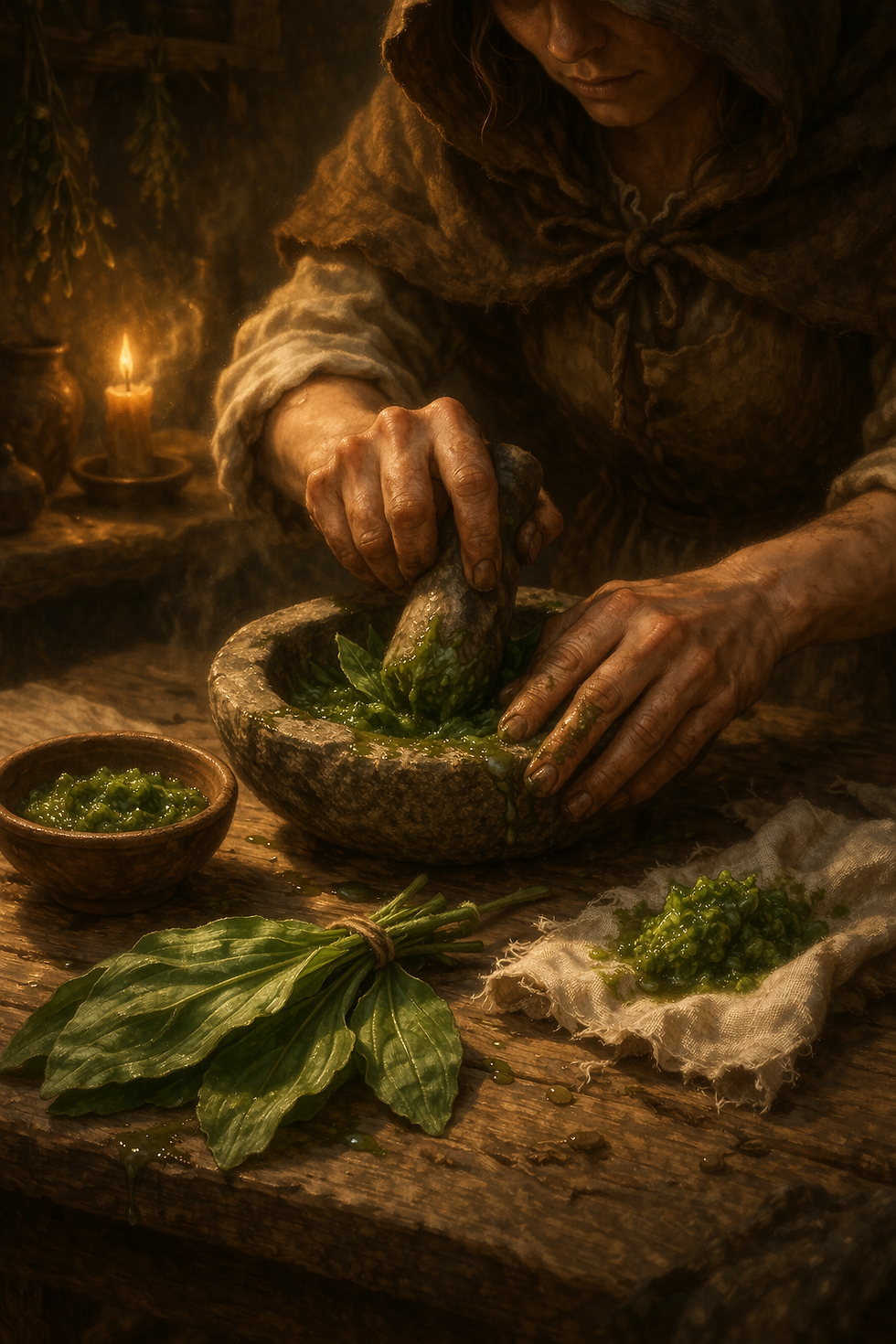
When crushed and applied directly to the skin—a method still used today—plantain acts as a natural poultice, helping to draw out irritation while supporting healing.
This isn’t just tradition catching up with science. It’s science confirming what tradition already knew.
A Medicine of the People

Unlike rare or region-specific herbs, plantain’s greatest strength is its accessibility.
It doesn’t require cultivation.
It doesn’t demand ideal conditions.
It simply grows—wherever people are.
This made it a “people’s medicine”—a plant available to anyone, regardless of status or wealth. In times when access to formal medical care was limited or nonexistent, plantain offered a dependable first line of defense.
Even today, foragers and herbalists continue to rely on plantain as a foundational remedy—something to reach for when you need immediate, effective support from the land itself.
Then vs. Now: What We’ve Forgotten
In modern life, plantain is often pulled, sprayed, or ignored entirely. It’s labeled a nuisance in lawns and gardens—a weed to be eliminated.
But this shift says more about us than it does about the plant.
As industrial medicine advanced, many everyday plant remedies faded from common knowledge. Convenience replaced familiarity. Bottles replaced leaves.
Yet the plant never left.
It still grows at our feet.
Still offers the same properties.
Still carries the same potential.

The question isn’t whether plantain works.
It’s whether we remember how to use it.
Rediscovering the Remedy Beneath Your Feet
Plantain’s story is a reminder that not all powerful remedies come from distant places or complex processes. Some of the most effective solutions are the ones we’ve walked past a thousand times.
It represents a different way of thinking about health—one rooted in observation, tradition, and connection to the natural world.
You don’t need to search far to find it.
You just need to recognize it.
Because sometimes, the most powerful medicine…
is already beneath your feet.
Works Cited
U.S. National Library of Medicine. Plantago major: Phytochemistry and pharmacological properties.
World Health Organization (WHO). WHO Monographs on Selected Medicinal Plants.
European Medicines Agency (EMA). Assessment report on Plantago lanceolata L., folium.
University of Maryland Medical Center (archived). Plantain (Plantago species) – Herbal Medicine Overview.
Chevallier, Andrew. Encyclopedia of Herbal Medicine. DK Publishing.
Grieve, M. A Modern Herbal.


Comments