
The Hidden History of Plants: Comfrey — The “Bone Knitter”

The Hidden History of Plants: Comfrey — The “Bone Knitter”
For centuries, long before modern medicine formalized healing, there were plants that people turned to in times of injury and pain. Among them, few carry a reputation as powerful—or as misunderstood—as comfrey.
Known as the “bone knitter,” comfrey has been used across cultures as a remedy for wounds, fractures, and inflammation. But its story is more than just healing—it’s a lesson in both the power and the caution required when working with plants.
Let’s step back into its history.
A Plant Rooted in Ancient Healing

Comfrey (Symphytum officinale) has been used medicinally for over 2,000 years. Its name comes from the Latin conferre, meaning “to bring together”—a direct reference to its traditional use in helping bones and tissues heal.
Ancient Greek physicians, including Dioscorides, documented comfrey in early medical texts. In his work De Materia Medica, he described its use for:
Healing wounds
Treating broken bones
Reducing inflammation
Similarly, Pliny the Elder recorded comfrey as a plant capable of “joining together” flesh—reinforcing its long-standing association with recovery and repair.
By the medieval period, comfrey had become a staple in European herbal medicine. Monastic healers and folk practitioners used poultices made from its roots and leaves to treat bruises, sprains, and fractures.
This is where the name “bone knitter” truly took hold.
Why Was It Called the “Bone Knitter”?

The nickname wasn’t poetic—it was observational.
Comfrey contains a compound called allantoin, which has been shown to promote cell proliferation and tissue regeneration. In simple terms, it helps the body rebuild itself faster.
When applied externally:
It encourages skin repair
Supports connective tissue healing
May reduce inflammation and pain
This made it especially valuable in a time when broken bones and deep wounds had limited treatment options.
However, there’s an important detail many people miss…
Comfrey can heal too quickly.
Traditional herbalists warned that if applied to deep wounds, the surface could close before the underlying tissue had properly healed—potentially trapping infection inside. This is one of the earliest recorded examples of plant-based medicine requiring not just knowledge—but restraint.
From Folk Medicine to Modern Research

Today, comfrey has been studied for its effectiveness in treating musculoskeletal pain and injuries.
Modern clinical research supports some of its traditional uses—particularly for topical application. Studies have found that comfrey-based creams can help with:
Back pain
Sprains and strains
Osteoarthritis
In fact, the European Medicines Agency recognizes topical comfrey preparations as a traditional herbal medicinal product for certain types of pain and inflammation.
But modern science has also clarified its risks.
The Danger Behind the Power
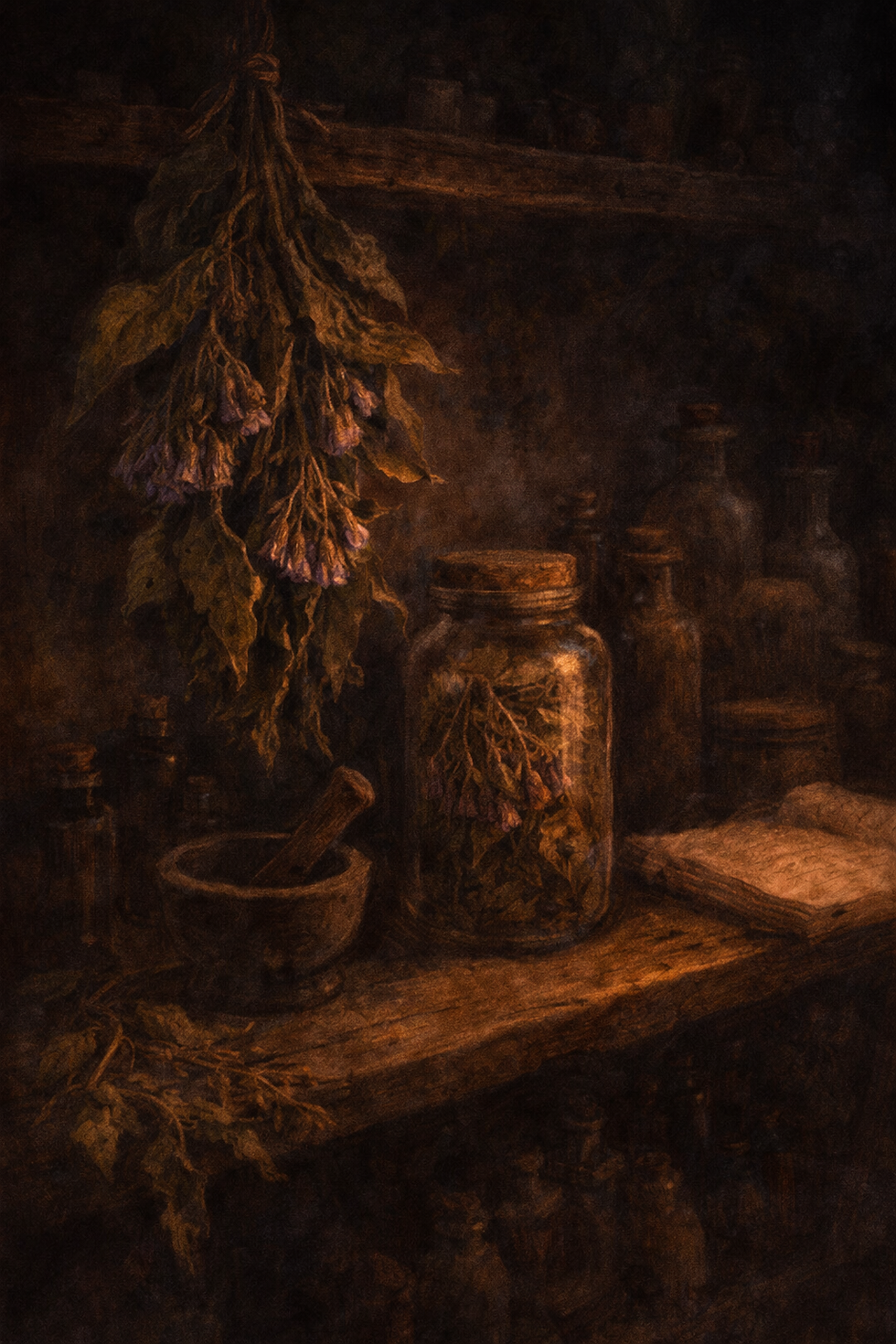
Comfrey contains compounds known as pyrrolizidine alkaloids (PAs), which can be toxic to the liver when ingested.
Because of this:
Internal use of comfrey is not recommended
Many countries restrict or regulate its use in oral products
Even topical use is advised only on intact skin and for limited durations
Organizations like the U.S. Food and Drug Administration and the National Institutes of Health have issued warnings about internal consumption due to potential liver toxicity.
This is where comfrey’s story shifts—from miracle plant to a reminder:
Natural does not mean risk-free.
A Plant That Demands Respect

Comfrey is one of the clearest examples of the dual nature of herbal medicine.
On one hand, it has a long, well-documented history of supporting healing—particularly when used externally for injuries and inflammation.
On the other, it carries real risks if used improperly.
The herbalists of the past understood this balance. They didn’t just use plants—they studied them, respected them, and passed down knowledge with caution built in.
That’s the real lesson of comfrey.
Final Thoughts: The Wisdom in the Roots
The story of comfrey isn’t just about healing bones—it’s about understanding limits.
In a world that often looks for simple answers, comfrey reminds us that true healing is more complex. It requires knowledge, patience, and respect for the tools we use.
Because sometimes, the most powerful remedies are also the ones that demand the most care.
Works Cited
European Medicines Agency (EMA). Assessment report on Symphytum officinale L., radix
National Institutes of Health (NIH), National Center for Complementary and Integrative Health. “Comfrey”
U.S. Food and Drug Administration (FDA). Consumer Advisory on Comfrey Products
Staiger, C. (2012). “Comfrey: A Clinical Overview.” Phytotherapy Research
Duke, J.A. (2002). Handbook of Medicinal Herbs
Dioscorides, P. De Materia Medica (1st century AD)
Pliny the Elder. Natural History (1st century AD)



Comments