
The Hidden History of Plants — Juniper: The Fire That Cleanses
The Hidden History of Plants — Juniper: The Fire That Cleanses
Introduction

For centuries, juniper has stood at the intersection of medicine, ritual, and survival. With its sharp, resinous scent and unmistakable presence in wild landscapes, this hardy evergreen has long been associated with purification—of spaces, of bodies, and even of unseen forces.
In this chapter of The Hidden History of Plants, we explore how juniper earned its reputation as “The Fire That Cleanses”—a plant burned, brewed, and believed to protect across cultures and generations.
What Is Juniper?
Juniper refers to a genus of coniferous plants in the Juniperus family, most notably Juniperus communis, the common juniper. It produces small, berry-like cones—commonly called juniper berries—which have been used in food, medicine, and ritual practices for thousands of years.
Native to regions across Europe, Asia, and North America, juniper thrives in harsh environments—rocky soils, cold climates, and exposed hillsides—making it both resilient and widely accessible to early cultures.
Ancient Uses: Protection Through Smoke

One of juniper’s most enduring roles is its use as a purifying smoke.
In ancient Europe, juniper branches were burned to cleanse homes and protect against illness. During outbreaks of disease—especially in the Middle Ages—juniper smoke was used in an attempt to ward off what people believed were harmful “miasmas,” or corrupted air.
Similarly, various Indigenous cultures of North America used juniper in smudging practices, burning it to purify spaces, objects, and individuals. While often compared to other sacred plants, juniper held its own place as a powerful cleansing agent.
The act of burning juniper wasn’t just symbolic—it may have had real-world benefits. Juniper smoke contains compounds with antimicrobial properties, which likely contributed to its long-standing association with protection and purification.
Juniper in Traditional Medicine

Juniper berries have been used medicinally across multiple traditions, including Greek, Roman, and later European herbal practices.
Historically, juniper was used to:
Support digestion
Act as a diuretic
Help with respiratory conditions
Stimulate appetite
Cleanse wounds (topically)
Ancient Greek physicians, including those following the teachings of Hippocrates, documented the use of juniper for cleansing and detoxification. Later, in European herbal traditions, it became a staple for supporting the body’s natural elimination processes.
Juniper’s essential oils—rich in compounds like alpha-pinene—are now known to have antibacterial and antifungal properties, lending scientific support to some of its traditional uses.
The Berry That Became Spirit: Juniper and Gin
Juniper’s influence extends beyond medicine and ritual—it also shaped one of the most iconic spirits in history: gin.
The word “gin” originates from the Dutch word jenever, derived from juniperus. In the 16th and 17th centuries, juniper was used to flavor distilled spirits, originally for medicinal purposes.
Dutch physicians created early versions of gin as a treatment for kidney ailments and digestive issues. Over time, it evolved into a widely consumed beverage, spreading across Europe and eventually the world.
Even today, juniper remains the defining flavor of gin—its sharp, pine-like profile unmistakable in every sip.
A Plant of Fire and Thresholds

Juniper has long been associated with thresholds—the spaces between worlds, states, or conditions.
Branches were often hung above doorways to prevent the entry of illness or negative influence. In some traditions, juniper was burned during important life transitions—birth, death, or seasonal changes—to cleanse and protect those passing through these moments.
Its connection to fire is both literal and symbolic:
Literal: burned as smoke for purification
Symbolic: representing transformation, renewal, and protection
This dual nature is what gives rise to its identity as “The Fire That Cleanses.”
Modern Uses and Cautions
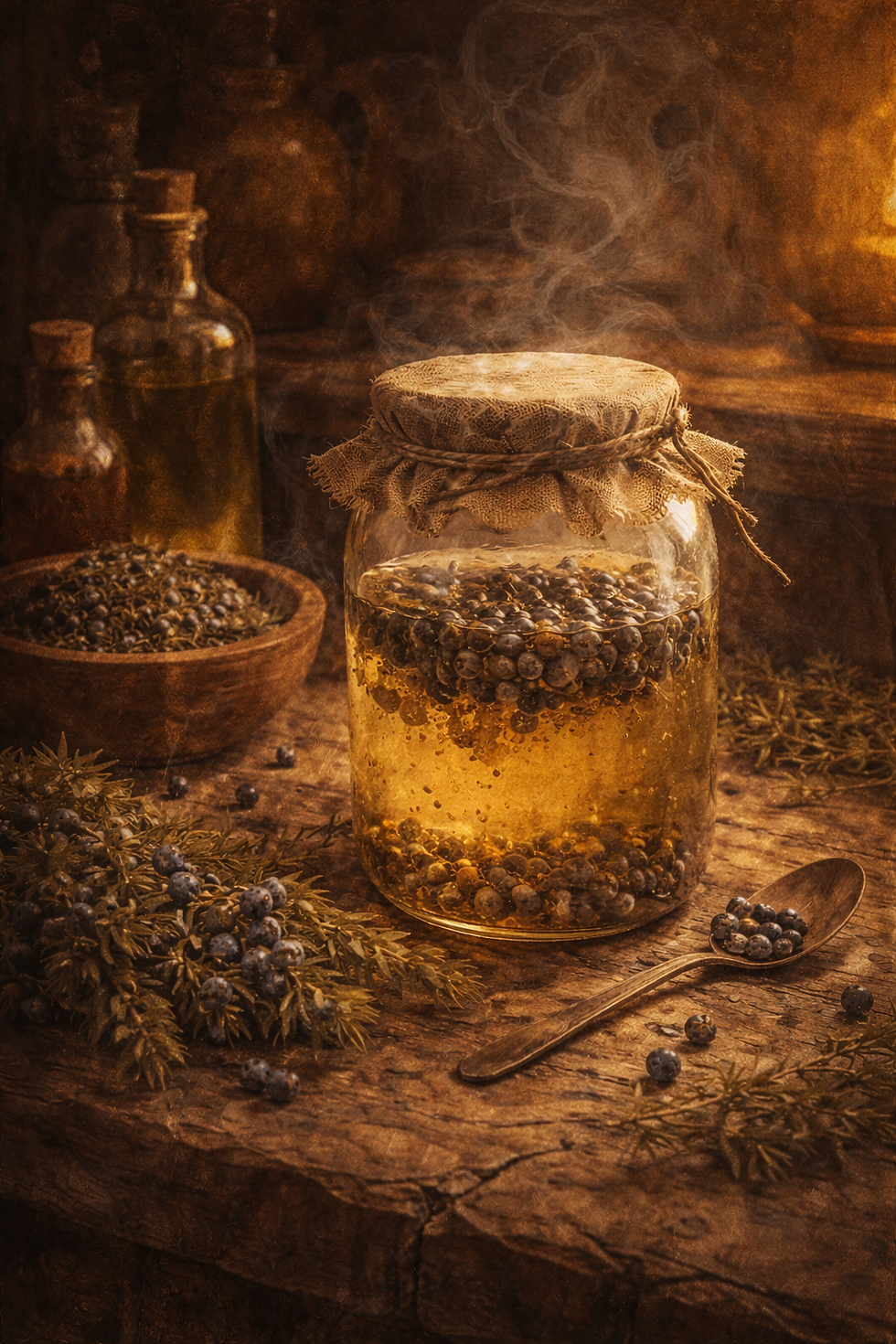
Today, juniper continues to be used in herbalism and natural wellness practices, though with more refined understanding and caution.
Modern uses include:
Essential oils for aromatherapy
Herbal preparations for digestive and urinary support
Culinary uses (especially in game meats and spice blends)
However, juniper is not without risk. It should be used carefully, particularly:
During pregnancy
In individuals with kidney conditions
In excessive or prolonged doses
As with any herbal remedy, informed use is essential.
Conclusion: Why Juniper Still Matters
Juniper’s story is one of endurance—both in nature and in human tradition.
It survived harsh climates, ancient pandemics, and centuries of evolving medical knowledge. And through it all, one theme remains constant:
People turned to juniper when they needed to cleanse, protect, and begin again.
Whether burned in ritual, brewed in medicine, or distilled into spirits, juniper continues to bridge the gap between the physical and the symbolic.
It is not just a plant of the past—it is a reminder that sometimes, the oldest remedies still carry the strongest meaning.
Sources
National Center for Biotechnology Information (NCBI) – Studies on juniper essential oil antimicrobial properties
European Medicines Agency – Herbal monograph on Juniperus communis
Royal Botanic Gardens, Kew – Botanical and historical data on juniper
Encyclopaedia Britannica – Historical uses of juniper and origin of gin
World Health Organization – Traditional medicine monographs



Comments